Wednesday, March 11, 2015

New Classes and Riga Adventures

Terve and welcome back again to Seikkailu Suomessa!  A lot has happened since the last time I posted, and to start, I'll cover what has been going on at school and talk about my recent excursion to the capital city of Latvia known as Riga.

School:
Since the last time I posted, I have started to get heavily involved in my newest class, Product and Brand Management.  Now that I have seen the workload of two classes here, the way that the major specific classes work at Aalto is a little more clear for me.  For the most part, school work is very much a self motivated thing.  Almost none of the classes have attendance requirements, but it is a very good idea to show up, because not showing can mean that you miss out on a lot of information. Another element to school work here is doing cases.  Both of my business classes have had a heavy focus on cases, and after talking to other exchange students, it is clear that Aalto tries to focus on both the theory and practical applications of the course.  In my first class, it focused mostly on cases that had already happened, but this Brand Management class also includes what is known as a "live" case, where the issue that you are trying to solve in the case is a current issue for the company.  My group and I just finished a case today covering corporate level branding for a Swedish steel company known as SSAB.

Outside class, you also have a ton of reading that has to be done before you get to class.  For my Purchasing class, we usually had to read about 20-30 pages of material before class, but for the Brand Management class, we have approximately 30-50 that has to be completed before class every Tuesday and Thursday.  The cases also apply to outside work, since you will have to meet with your group to manage the workload, but it is manageable.

Aalto also has these classes that they call "book exams" and it is where you are responsible for learning all of the material needed for the exam.  you do not meet for lectures and you don't really get any information from anyone about the exam.  With these types of classes, making sure that you keep on top of your reading is very, very important.

That's enough about classes for now, lets talk about Riga, Latvia.

Riga, Latvia: Background Information

Riga is the capital city of the country known as Latvia.  While Latvia has only had independence for about 20 years, the city of Riga dates back to about the year 1207.  The city was originally founded by a bishop from Europe to help extend Christianity to the east.  It was then inhabited by German merchants and crusaders participating in the Northern Crusades.  The city soon became divided by the three factions, with the merchants eventually gaining the biggest amount of control.  Since that time, Riga became one of the most important trade cities in the Hanseatic League.  The city was eventually taken by the Swedish empire and at one point, Riga was larger than the capital of Stockholm.  Later on, Riga became a part of the Russian Empire and was the third biggest city, behind Moscow and St. Petersburg.  Riga, and Latvia, remained part of Russia until after World War I.  The Latvian people declared independence in the 1930's and erected the Freedom Monument to commemorate the occasion.  The freedom was not long lived, and during World War II, the country and city were occupied by both the Nazis and Soviet armies, with the Soviets maintaining control until the fall of the Soviet Union.  Today, Latvia is a proud member of the European Union and the city of Riga served as the culture capital of the EU last year, and is serving as the Presidency of the EU until this July.  If you talk to any Latvians around Riga, most of them feel very optimistic about their country's future and are proud of the strides that the country has been making to improve.

Riga: The Trip Day One

I arrived in Riga on a Friday, and I was very surprised by how modern that the main airport of Riga (RIX) looked and it looks better than some American airports I have visited.  Like most European cities, public transportation is a easy method for moving within the city and compared to Finland and Sweden, the buses in Riga are very cheap, with a ticket costing about 2 euros.  It took about 30 minutes to get to the city, and while the outside fringes of the city don't look the best, most of the buildings just appear to need a fresh coat of paint and some gardening.

Once I arrived in the city center, my companion Alyssa and I made our way to our hostel in the Old Town.  We left our belongings in the hostel and decided to explore some of the city.  We started by paying a visit to the central market, where you can find everything from fresh fruit and flowers, to electronics and even Soviet memorabilia. The outdoor portion of the market is mostly just open air stalls with the vendors showing off their merchandise.  The indoor portion however, is housed within these old Soviet era hangars (the four round roof buildings in the right side of the photo).  This area was one of my favorites in the city, just because of everything you can see and the different kinds of people selling their wares at the market.

After seeing the market and buying a few souvenirs, we decided to head into the heart of the Old Town to see the sights.  Riga has a style that is pretty unique compared to the other cities I have visited.  We made our way down the winding cobblestone roads to the main square containing the famous House of the Blackheads.  While the original building was made in the 15th century, it was destroyed and the building you see has only been around for a few decades.  The building was originally built for the single merchants that came to the town, with the smaller red building on the left being meant for the married merchants.  We continued to look around the Old Town, and eventually found our way to the Freedom Monument and saw some of the churches in the area.  Following our exploration of the Old Town, we followed the recommendation of the hostel and had dinner at this Irish pub called Paddy Whelan's.
Riga: Trip Day Two

As it turned out, there are free walking tours of the Old Town offered every day in English at 11 or 12.  We met the tour guide in front of St. Peters Church (there's a lot of photos for this so they will be included at the end) and began our one hour tour.  Our guide explained all about the different art-nuveau sculptures that Riga is known for and we also got to see the infamous "Black-Cat House". Since the German merchants would not allow the Latvian people to join the merchants, one well known family set up a Latvian merchant house, using a black cat as the symbol.  At first there was only one cat, and the Latvian merchants had the cat facing away from the German merchants.  After seeing that, the Germans allowed the Latvians to join their ranks and the Latvians added a second black cat to the house, this time facing the German merchants.  Riga used to have a massive wall, with many gates surrounding the city, but today only one section of the wall remains, and only a few of the original gates exist.  We followed our guide to a few other sights, and ended the tour in an alley way behind the St. Peter's Church.  After the tour, we decided to go to the top of the tower and see the city.  It cost about 7 euros to go up the tower and see the church, but the city is massive and seeing it from that perspective was amazing.  We tried to check out a few of the museums and the castle, but unfortunately most of them were closed for renovations while we were there.
St. Peters Church
Portion of the tour at the narrowest street in the city.


The Black Cat House
Example of Art Neveau in Riga


View of one part of the city from the tower.


Riga: Trip Day Three

We had a bit of an earlier flight on Sunday, so we didn't have as much time to see a lot, and since most places in Riga don't open until about 12 on Sundays, there wasn't much we could see.  Out of all of the places that I have visited so far, Riga has been the favorite so far.  Despite being so close to Sweden, Finland and Estonia, the city feels so different from all of those places and creates a wonderful atmosphere.

Next Trip Hint:

I didn't do this last time, but I am so excited for my next trip, so I want to give you guys a hint as to where it will be.  I have mentioned the city/country in this post and here is a photo of the location (hint it may not be the first place you think of):
Image result for St. Petersburg Russia
courtesy of google image search
Thank you all for reading, and congratualtions to Dawn Staley and the Lady Gamecocks for capturing the SEC regular season and SEC Women's Basketball championships.  No matter where you go, its always great to be a Gamecock!  Until next time!

Wednesday, February 25, 2015

Exams and Excursions

Tervetuloa, these past two weeks have been pretty busy, with the first of my exams occurring last week, and taking a little weekend trip to Stockholm, Sweden.

Since Aalto University has three periods during the Spring semester, that unfortunately means that you also have at least a few final exam periods.  Thankfully I only had one exam, my Purchasing and Supply Management course, so preparing for it was simpler than at USC where you have all of your exams at the same time.  Unlike USC, you have to actually sign up for the exam, and if you forget to sign up in time, you can't take the exam.  Once you have signed up and the day of the exam comes up, you have to go to the main building to check where the exam is being held.  This means that you have to be early for the exam, since you might have to go to another building and being late for an exam is considered unacceptable here at Aalto.  My exam took place in the Arkadia building that was near by.  Another note about these exams, they usually last about 4 hours, but based on what other students have told me, it should never take 4 hours for most exams.  The reason they allot 4 hours is to help students who may need the time.  The exams tend to be essay based with multiple choice style questions being rare.  My exam was only 4 questions, with one full essay, a short description of a podcast that we did earlier in the course, a mini essay, and some vocabulary definitions.  During exam week, like at USC, there are no classes, so since I had a small break, me and a friend decided to take a weekend trip to the capital of Sweden, Stockholm.

Background Information
This is just a little information about Stockholm, if you aren't familiar with the city.  Stockholm is the largest city in Sweden, and serves as the capital.  The city has been around for a very long time, with the original palace, known as the Tre Kronor Palace, dating back to the 13th century.  At one time, Sweden was one of the most powerful kingdoms in Europe and controlled most of the Nordic countries (Norway, Finland) with Denmark being the only exception.  The Old Town of Stockholm is known as Gamla Stan in Swedish and is actually on a separate island from the rest of the city with many bridges leading tourists and locals into it.  One such entrance leads through the Riksdag or the Swedish Parliament, pictured below.  Sweden is considered a constitutional monarchy, with the current king being Carl XVI Gustaf and Stockholm still serves as the residence of the royal family.  Currently, Sweden is a part of the European Union, but does not use the Euro as its currency.  The currency of Sweden is known as the Kronor.


The Trip Day One:
My travel companion, Alyssa, and I set out for Helsinki's airport at about 10am and took a flight on FinnAir.  We left at 1pm, and thanks to the time zone between Helsinki and Stockholm, the flight took no time at all.  As with most European cities, there are multiple ways to get into the city from the airport.  If you are arriving from another country, you'll most likely arrive at Arlandia airport and there are two main ways to reach the city.  The first is an express train that costs about 480 Kronor for a round trip (about 48 Euros).  The way that we used was the airport shuttle that was half the cost of the train.  We had made reservations to stay at the City Backpackers Hostel and once we arrived at the central station, we followed the instructions to get to the hostel.  We took about an hour to organize our belongings and figure out what we wanted to do.  For the most part, we spent the first day in Stockholm in the Old Town and just wandering around the city.  Despite not visiting any museums, just walking around and taking in the sights was a good way to begin to familiarize ourselves with the city.  While we were in the Old Town, we happened to find a street that had many restaurants and cafes, and since it was close to dinner time, we chose a nice Pakistani/Indian restaurant.  For about 220 Kronor, I was able to get a large portion of chicken biryani as well as a large piece of garlic naan bread and a glass of soda.  It hit during the meal that I am an American, studying in Finland, traveling with an Australian, visiting Sweden while eating in an Indian restaurant and it was funny to consider how multicultural it seemed.

The Trip Day Two:
Alyssa and I decided to head to the Vasa Museum and possibly try to see the ABBA museum.  We did a little research to find out where the Vasa Museum was located, and how we wanted to get there.  After finding out that the public transportation in Stockholm does not accept cash, we decided to walk the 30 minutes it would take to get to the Djurgarden district where the museum was located.  When we got there, we were amazed to see the Vasa.  The Vasa is a 17th century Swedish warship that had been sunk for over 300 years.  While I wish I could say that the ship was involved in many battles, the truth is that the Vasa was not built properly and only got 1500 meters into its maiden voyage before sinking.  Knowing that doesn't take away from the sense of awe that you get, knowing that you are looking at one of the only examples of these type of ships.  The ship itself is massive, and the museum spans 4 or 5 floors, each displaying new views and information about the ship.  The ship just has an enormous amount of detail and had over 500 sculptures including 20 statues of Roman emperors that the Swedish monarchy claimed as part of their lineage.  Its even more astonishing when you see an example of the different colors that were possibly used to decorate the ship.  There were also exhibits on how the sailors would have looked and the events that lead to the Vasa being built and ultimately sunk.
A view of the Vasa from the side
The back of the Vasa
Some examples of colors used in the Vasa's sculptures


The Nordisk Museum
While taking a break from the Vasa, we decided to look up where the ABBA Museum was located and how much it would cost, we found out that the museum would cost about 250 Kronor (25 Euros) and that the museum does not accept cash so we decided to scrap that idea, which I wasn't heartbroken over since I never listened to ABBA's music.  We decided instead to pay a visit to the Nordisk Museum, which is a museum that shows examples of Swedish culture through the years and some other exhibits.  There are examples of how Swedish households evolved from the decline of Swedish power to the modern era.  It also had some examples of what games Swedish kids would play and how they were expected to act with their parents.  One of the more interesting exhibits was the one covering Sweden's addiction to sugar and different examples of commercials from the 1950's to more modern advertisements. Another interesting exhibit was the evolution of Swedish fashion through the years and a lot of the styles from the 60's and 70's were very similar to what you would have seen in the United States.

After visiting the museums, we decided to head back to our hostel and on our way back we decided to visit a church we had found, and we happened to be walking into an organ concert playing songs from Johann Sebastian Bach.  We stuck around for most of the concert, which was a very cool experience.  I had never heard a church organ used inside a church before, and it creates a sound that is hard to put into words.  When we had heard about half the concert, we left and indulged in the free food that the hostel was offering that night.

The Trip Day Three and Four:
We spent the last two days in Stockholm back in the Old Town, specifically around the complex of the Royal Palace.  When His Majesty is not using the Palace, much of it is open to visitors.  For about 150 Kronor, you get access to three areas of the Palace, the Treasury, State Apartments and the Tre Kronor museums.  We started with the Treasury, which contains many of the regalia of the 17th-19th century Swedish monarchs.  We took an English tour and learned that the reason that the current king does not wear a crown or use other forms of regalia is because they have not been coronated.  A coronation is when a representative of the Christian faith blesses the ruler and if a ruler has not had a coronation, they are not seen with a crown or with the stereotypical red and white robe.  The Swedish royal family is still Christian, but due to the high level of expenses of a coronation, in the 20th century the family decided not to use state money for the ceremony. I would have some photos to show, but the museum does not allow photos of any kind in the Treasury.

After the Treasury, we paid a visit to the State Apartments, where the royal family used to live and where guests to the Palace would often stay.  This museum mostly consisted of different rooms that were used by the family, including the audience chambers for both the queen and king of Sweden.  Some of the rooms are still used, particularly the Council Chamber where the Swedish government receives foreign representatives for meetings.

The last of the three museums is dedicated to the original palace, the Tre Kronor. In English, the name of the palace is the Three Crowns Castle.  It was originally built in the 13th century, but like most important stone buildings in Europe, burnt down sometime in the 16th century and was replaced by the current palace, but the North Wing of Tre Kronor survived and was incorporated into the new design, which is pictured below.

We also had a chance to see the changing of the guard.  On scheduled days, the Swedish Royal Guard will perform the ceremony and in the summer it is supposed to be an amazing ceremony to see, but even in the winter, it is a sight to behold.  It takes about 40 minutes, and involves a small group of soldiers standing in front of the palace, marching around the complex and finishing in the courtyard that leads to the different museums.


After seeing the Tre Kronor Museum and the changing of the guard, it was time to head back to the airport and head back to Helsinki.  Stockholm was an amazing city, and while I definitely want to go back someday, it is nice to be back in Helsinki.  That's pretty much everything for this update, but don't fear, I'll be back in two weeks with another update, and I might be showing off a new city, so be sure to check that out.  Until then, nahadaan!

Thursday, February 12, 2015

Snow, Snow, Snow and More Snow

Hyva paiva! I'm back to let you all know what I have been up to since the last time I updated the blog.  Last time, I talked about some issues that I was having with my bank, which is thankfully no longer a problem.  I also left a picture at the end of my last update as a hint to my next trip.  The answer was Lapland.  Lapland is the northern most province in Finland, and I spent about three days at the Levi resort.  I had a lot of fun and experienced things that I would have never been able to in the U.S, but it definitely gave me a new appreciation for winters in Virginia and South Carolina.
Image result for levi resort map     
Lapland:
The trip was organized by KY-Sub, which is the cultural subcommittee of KY (the business student union) and lasted from Wednesday night to Monday morning.  Following my class on Wednesday, I gathered my luggage and went into the city to begin our journey to the snowy region.  We left from Helsinki at about 9 P.M and it took nearly 15 hours (including stops) to get to Levi.  We arrived at our cabins at about 1 P.M  Thursday and spent the first night mostly exploring the resort and getting groceries since our cabins were equipped with full kitchens.  I did have photos of the cabin, but I forgot to put my camera's memory card in the camera, so I wasn't able to save any of the photos, unless they came from my phone.  We also went to the ski slope to pick up our tickets (shown right).

On Friday, we started out by visiting a traditional reindeer farm managed by some of the Sami people of Finland.  The Sami are the indigenous people of Finland and maintain their culture, with their capital being in Inari, another city in Lapland.  There were about 60 of us there, and I was part of the first group to get on the sleigh.  The ride itself didn't last very long, maybe about 20 minutes, but it was an experience that I think will be hard to forget.  After the ride, we spent time by a campfire the Sami owners had set up, and even had a chance to pet a few of the deer and even feed a few of the babies that they had nearby.


That same night, a friend of mine, Alyssa Currie, and I walked to a nearby shop called Lapland Safari to check in for our nighttime safari.  We booked tickets to go on a snowmobile ride to a nearby frozen lake to try and spot the Northern Lights.  Unfortunately, the weather didn't permit us to really see anything, but we spent about an hour with the other people on the tour in a cabin by the lake.  I wish I could say that I had been able to drive to the cabin on the snowmobile.  After we set out, we made it about 10 minutes into the trip before I had a bit of an accident.  The guides had explained how to drive the snowmobiles, but when I was going around a corner, I accidentally hit the gas instead of the brake and hit a snow bank.  No one got hurt, and the snowmobile was still in working condition, but I will probably wait to drive one again until I can practice more with an instructor.  Other than that, it was a very enjoyable trip.  That night I also learned something, the Finnish sauna is one of the most amazing things in the world.  Our cabin had a private sauna in it and it is easy to see why the Finnish people love them so much.  All you have to do is heat it up and drop water on the hot coals and sit there in the steam.

The next morning, I met with Alyssa again and made our way to the ski lift to begin our snowboarding lesson.  I chose snowboarding because everyone I had asked said that snowboarding was easier to learn than skiing.  I dont know if skiing would have been easier, but snowboarding was fun.  We met our instructor Tomi and he started us with some basic exercises.  The lesson lasted about an hour and a half.  I fell a lot and had trouble with the basics, but learning a new sport was really cool.

Following the lesson, I met up with my cabin mates and convinced them that we should go bowling for a little while.  We enjoyed the game for about an hour and decided after our second game to call it quits.  That night I went to a Lapish restaurant to try some examples of the local food.  I did try some reindeer meat which is a common protein in Lapland, and it was something that you just have to try for yourself.

Santa Claus Village:
We left for Helsinki at about noon on Sunday and our first stop was at the Santa Claus Village in Rovaniemi (the provincial capital of Lapland).  If you didn't know, Finland claims to be the official home of Santa Claus, and it would seem that the many diplomats and celebrities that visit the village agree.  I did get to meet the "real" Santa, and despite being 20 years old, it was really cool.  The village also has various shops and cafes for tourists and even has its own post office that will mail cards with an official Christmas Village stamp.  The post office will even get your letter mailed by Christmas if you want.  We spent about two hours at the village before heading back on the bus and going back to Helsinki.

School:

It felt somewhat weird going back to school after the trip, but it feels even weirder to say that I already have final exams next week.  I will post again next Wednesday to explain how the Finnish students handle exam week and what the exam was like.  Until then, Moi moi and Go Gamecocks!

Wednesday, January 28, 2015

Banking Fails and Tall(inn) Tales

    I know that I said I would be updating you guys every week with what was going on here in Finland, but in the week following my last post, there just wasn't much to really say.  To get started, I'll let you know what I've doing the past two weeks.

My classes have been going well, and last Monday I started my Finnish Language and Culture class, which will be lasting the entire semester.  So far it has been interesting and the Finnish language is very different from English and German.  For one thing, the Finnish language has no genders, unlike German where you can have masculine, feminine, and neuter (neutral) nouns that affect the different articles attached to them.  For the Finnish, they only have one word for he/she and they use it interchangeably.  Another aspect of the language that makes it strange is the fact that you have instances of double letters (aa, ii, kk, etc.) that drastically affect the pronunciation, but in Finnish you have to pronounce every letter in the word, so it is very important to recognize the double letters or you can go from calling someone their name to calling them a "toilet".  It is also interesting that the Finnish language is constantly trying to adapt to new words in order to keep the language strictly Finnish.  One of the examples given by my professor was the word computer.  For the most part, many languages just simply use the word computer.  The Finnish, however, have adapted the word to be made of the words "information" and "machine" leading them to using the word "tietokone".  I have only just started the class, so I'm not really able to speak much outside of saying "mina olen Evan ja mina olen amerikkalainen", which basically means that I am Evan and I am an American.  You might notice that I didn't capitalize the Finnish word for American, and that's because the Finnish don't capitalize nouns, even proper nouns, unless they start the sentence.

Sitsi Parties:

While I am on the topic of language and culture, I had the chance to attend a Sitsi party the Friday following my last post, and it was a strange experience to say the least.  For people not familiar with a Sitsi party, it can be a formal or informal gathering where participants can come together and enjoy each other's company.  There are several rules to the Sitsi, some of which they don't tell you before hand.  One of the most important is that you never show up late to a Sitsi.  If it starts at 6 pm, you are there about 15 minutes before hand.  You then wait to be invited to sit at the table by Toastmaster, who will lead the entire party.  Some of the other rules vary from toastmaster to toastmaster, but another of our rules was that we were supposed to keep all electronics turned off and put away to encourage us to get to know who we were sitting with.  We were also grouped by what we listed as our home country and were expected to come up with a short five minute program representing our country.  During these programs, you were not allowed to talk, interrupt the program, or use the restroom.  After each program, we ate traditional Finnish food, sung songs and it lasted nearly three and a half hours.  It may have been long, but it was a ton of fun and I hope that I can attend other Sitsi parties.

Banking Fails:

Now I know that you are probably wondering why part of the title is called "banking fails", and the answer is simple, I lost my bank card and have been forced to open an account here in Finland so that I can transfer money to my account here and have a functional debit card.  I have an account set up with OP Pankki, which is a bank that was recommended by Aalto University for exchange students.  I had been planning on setting up an account, but I wasn't as pressed to do it before I lost my card.  I just recently realized that another problem is that my bank back in the U.S doesn't allow international transfers for a personal account so I have to rely on Western Union to be able to get the transfer set up.  The moral of this story: never do anything when you are abroad (or anywhere for that matter) without making sure that you keep important cards and documents in a very secure location that basically makes it impossible to lose them.

Tallinn Tales:
photo courtesy of visitestonia.com
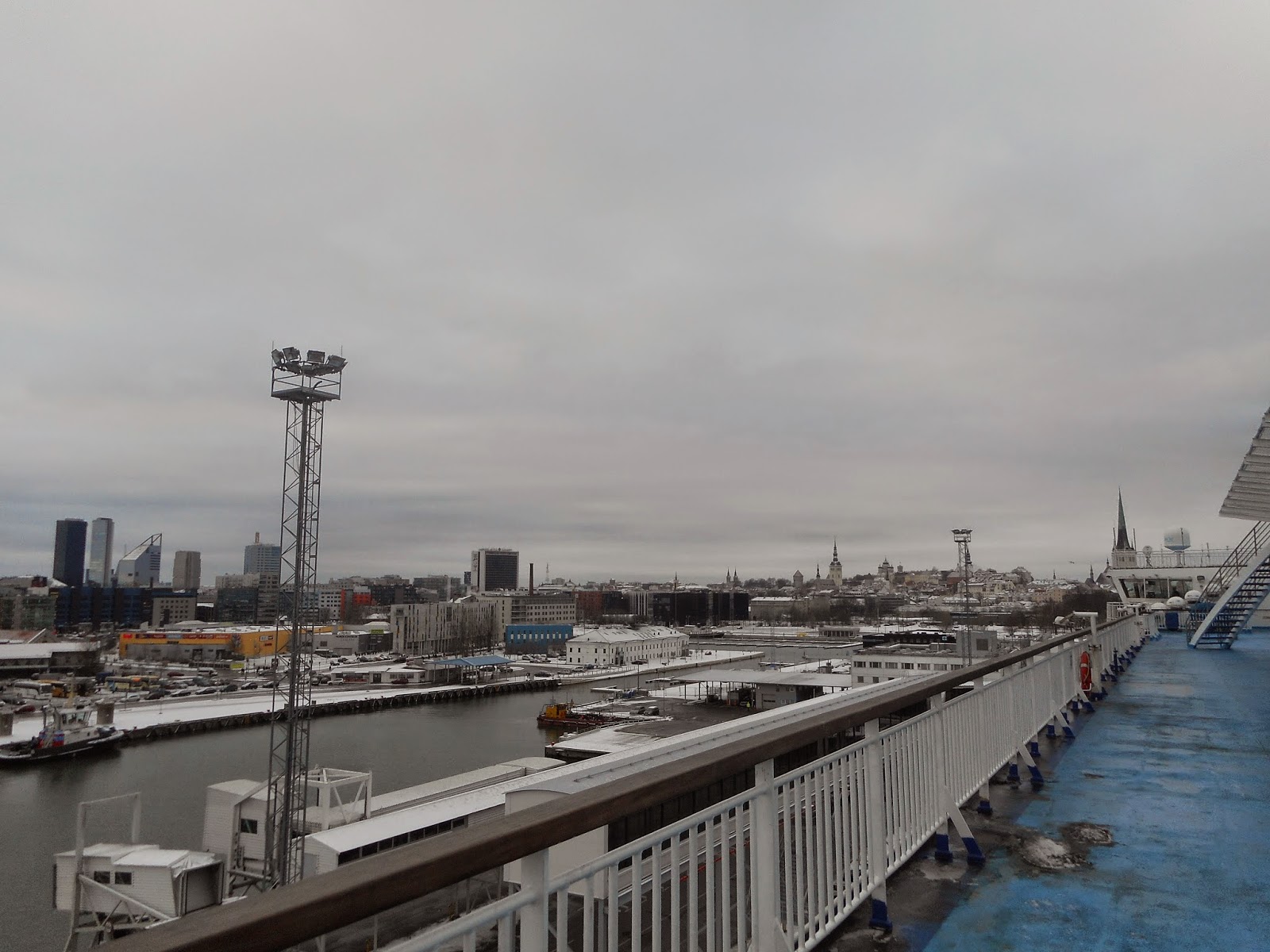
Ok, I think that's enough for the embarrassing tale, and time to explain the second part of the title.  This past Saturday, I had a chance to go and explore the Old Town of Tallinn, Estonia.  Tallinn is the capital of Estonia, and is surprisingly modern for a region that most Americans (myself included) would consider to be a poor country.  The journey started by selecting the ferry that I wanted to use to get there.  There are four main companies that handle trips from Helsinki to Tallinn.  The companies are:  the Silja Line, Viking Lines, Tallink, and the Eckero Line and most of them are fairly affordable to purchase tickets from.  I chose the Eckero Line mostly because they appeared to be the cheapest at 25 euros for a round trip ticket. Unfortunately the ship is so large that I couldn't really get a good view of it, so above is a photo of the M/S Finlandia operated by the Eckero Line for cruises to Tallinn.  My ferry left at 8:30 am, and the terminal it was located at was about 40 minutes away from my apartment, so I got up around 5:30 am, and made my way there.  Once I was on board, I simply waited for our three our trip to arrive in Estonia.  The photo on the right is the view of the city from the ship.  Once I landed, I made my way through the port (since Estonia and Finland are both part of the Schengen Zone, it isn't required to have a passport to enter the country) and found my way to the Old Town.  The country of Estonia has had a very rough history, with only two instances of the country having its independence, with the first coming after World War One, and the second coming when Estonia, Latvia, and Lithuania all decided to break away from the USSR.  The country has been divided between Sweden,  the Hanseatic League, the Teutonic Order, Livonian Order, and the Russians for the most part of its history.  The city of Tallinn was granted to the Hanseatic League following a crusade sanctioned by the Pope back in the 12th or 13th century.  Under the Hansa, the city became a major trading town and it is from mostly this time that the Old Town began to take shape.


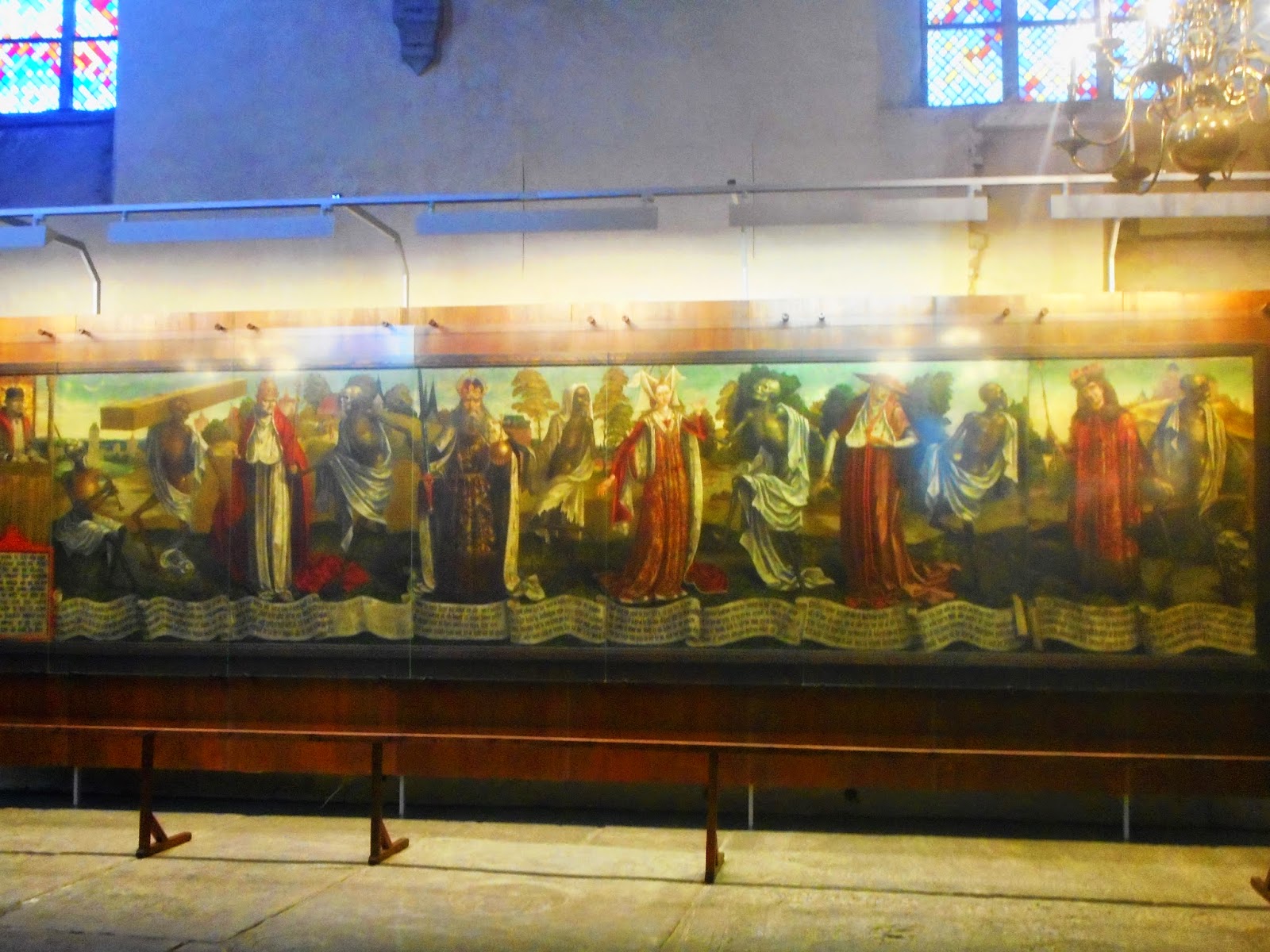
 This was the first gate that I encountered on my way into the Old Town.  Like most older cities in Europe, the main part of the city was defended by its city walls, and Tallinn still has many of its towers and gates intact along with the wall.  Once inside, the first thing you notice is how narrow all the streets are, and you know that it will be easy to get lost.  While I don't speak Estonian (or Eesti in Estonian), almost everything in the city is written in English, Finnish, Russian and sometimes German along with Eesti.  I started my journey in the lower section of the city.  It is known as the lower city because it was where all of the non upper class citizens lived, and coincidentally, the lower city is lower than the upper city.  After wandering for about an hour just trying to take in the sights, I finally decided to stop into the St. Nicholas Cathedral to check it out.  The cathedral is currently being used as a museum and includes a very unique painting called the "Danse Macabre" (pictured on the right).  The painting is an artifact from about the 15th century, and it is considering the last remaining set of paintings containing the dance of death.  The painting depicts death dancing with  the Pope, Holy Roman Emperor and other rulers and lower class people to show the equality of death.  It only cost five euros and was definitely a good way to kill some time.

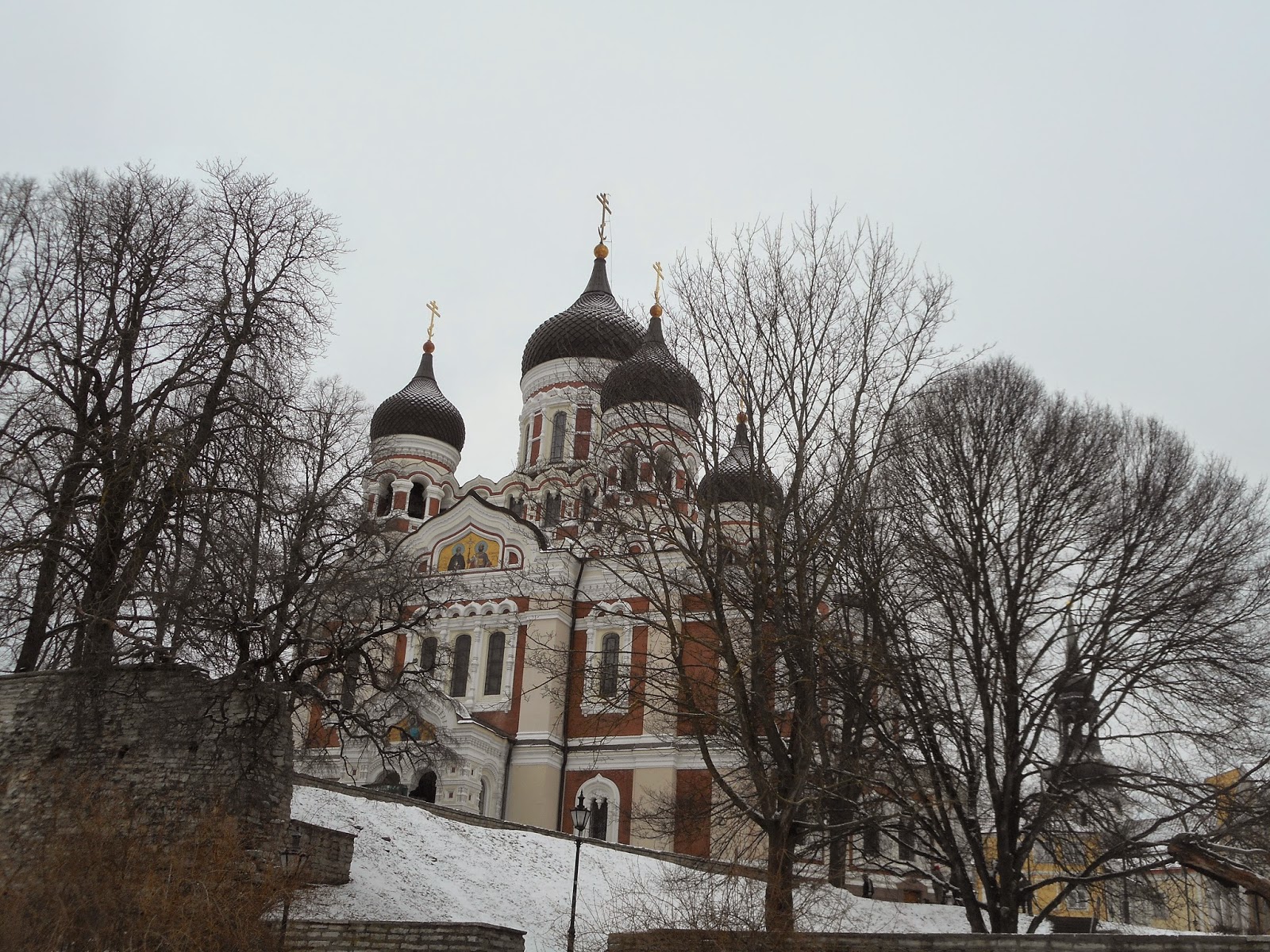
Following the street from the cathedral, I decided to continue wandering until I came across a gate leading to the upper city and decided to check it out.  What I found was an area that was not as narrow as the lower city, and housed the building currently being used by Estonian Government as their meeting area.  The most prominent building of the upper city however is the Orthodox Alexander Nevsky Cathedral (pictured to the right).  They didn't allow photo's or video cameras inside the building, but take my word for it, it is beautiful inside.  The ceiling is painted a lovely shade of blue, while the rest of the structure has almost a golden glow coming from it.  It is a fairly small cathedral and with some event taking place when I was there, most of the church was closed off.  After about 20 minutes in the cathedral, I started to feel hungry, so I decided to head down to the lower city for lunch.

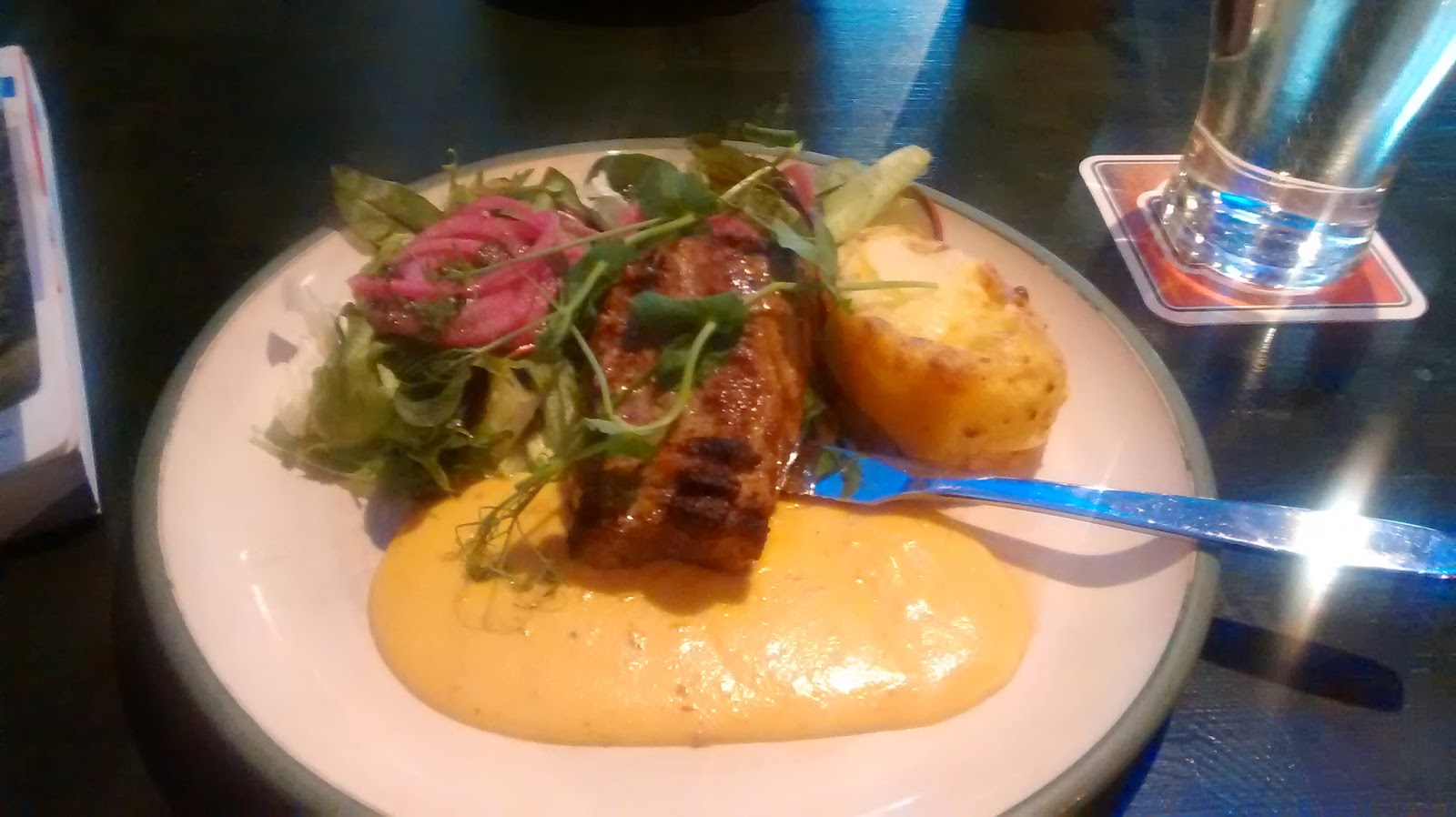
Remember how I said that the city was easy to get lost in?  Yeah, this was the first time I got lost.  I wandered the upper city for about 30 minutes before finally finding the gate that had led me to the upper city.  I then decided to simply walk down a random street in the lower city checking out the menus of the cafes and restaurants that I saw.  I finally settled on a pub nestled near a few shops.  The pub is called "Hell Hunt", which actually means gentle wolf in Eesti.  I got a nice meal for about 12 euros, including a service charge and a drink. As you can see above, you can get a decent amount of food for the price, and it gave me a chance to sit and relax after walking around for so long.

Following my meal, I decided to head back into the city and see what else I could find.  I happened to be walking down one of the streets and noticed an inconspicuous building that happened to be the Estonian History Museum.  As it turned out, the building that houses the museum is the original guild hall built by the Hansa in the 14th or 15th century.  It was a great way to learn more about the country and a few odd facts about the country.  Here's one: Skype was created by an Estonian, and another: The first recorded records of humans in Estonia was approximately 10,000 years ago.

I spent most of my remaining time in the museum and around 4 pm I decided to head back to the port so I could catch my boat back to Helsinki.  It was a good thing I got there early, because my original ferry had been cancelled and I had to transfer to the Viking Lines, which was pretty painless.  I loved my time in Tallinn, and I will probably be going back sometime in spring or summer to see what it looks like.

That does it for this update, and I'll be posting again in two weeks and I'll be visiting a new area and while I don't want to ruin where I'm going, I will give you a hint in the picture below.  Bye for now, and Go Gamecocks!

photo courtesy of Google images


Wednesday, January 14, 2015

A Week in the Life of a Walrus

   Hey guys, and welcome back to Seikkailu Suomessa!  Now that I have been in Finland for about a week, I just wanted to give you guys an update on what it has been like.  When I got off the plane at Helsinki-Vantaa, I met with one of Aalto University's tutors and she took me to get my apartment keys.  I spent most of my first night unpacking some of my belongings and sleeping.  After that I decided to venture out and see what was around my apartment.  There are a few restaurants in the area, as well as a popular grocery chain called Alepa within a few minutes of the apartment, and there is a shopping mall about 20 minutes away that has anything you could need.  I currently have two roommates; one is named Denis and is a Bulgarian who was born and raised in Spain, and the other is Jules, a native of the Ivory Coast who goes to school in France.  The set of apartments that I live in may not be the fanciest, but they are cheap, and the previous tenants have left behind things like dishes, pots, pans, blankets, pillows, ethernet cables, and some cleaning supplies, so its nice that I haven't had to go and buy these things.  The only thing that isn't too nice about living here is being about 20 minutes outside Helsinki's city center, but that is fairly minor, and I'll explain why later.  Now that I have given some basic information about my living situation, I'm gong to describe some of the other elements of life as university student here in Finland.

School:
   This is the Aalto University School of Business's main building.  The School of Business is divided into a few different buildings and a library.  As of right now, I haven't been able to explore many of the other buildings, but I plan on doing that sometime this month.  The main building doesn't look like much from the outside, but inside it is very nice, with multiple computer labs, a cafeteria, and various printing stations around the building.

  As I mentioned in an earlier post, Aalto University has split its Spring semester into three different periods, with the current period being Period Three.  Right now I am taking my Inventory and Supply Management class, which so far has not been too different from the way that USC conducts its classes.  The main difference is that my class lasts about 90 minutes to two hours, which is about twice as long as a normal class at USC.  Given that I have only experienced one course at this point, I can't comment too much on what all of the classes at Aalto are like, but as the semester goes on, I will provide updates on what they are like.

AYY, KY, and Social Life:
   You are probably wondering what AYY and KY are, and to start, I'll talk about AYY.  AYY is simply the student union that is responsible for helping all of the students at Aalto University,  They also organize events for students, and provide tutors for the exchange students.  Once you decide to attend Aalto, you are required to join AYY, and there is no exception.  KY is a part of AYY, but is an organization that focuses on helping business students rather than the entire university.  They are responsible for arranging most of the events that I will be attending this semester, including a Finnish Sitsi party that I will discuss in my next update.  KY is also the reason that the word walrus is in the title of this post.  When you join KY, during the first year you are called a walrus, which my tutors explained is because the Finnish word for walrus is similar to another Finnish word relating to education and it simply devolved to walrus after time.

   As I mentioned, if you are an exchange student at Aalto, you are assigned tutors that are there to help answer any questions that you may have about Aalto or Finland in general.  Each set of tutors have a group consisting of about seven to ten students.  In my group, there is only me and another girl from the United States and the rest come from countries like Spain, Germany, Switzerland, Singapore, Canada and Malaysia.  During our first day of orientation, our tutors took us on a tour of the campus and took us to get our travel cards, which are the best way to use public transport in Helsinki.

   Last Tuesday was my first cultural event in Finland, and it was called the Lux Festival.  Basically it is a festival that allows artists from around Finland set up displays involving light in some way.  There were about eight exhibits and some of them were fairly strange.  My personal favorite was the fire-dancing show that took place on the steps of the Helsinki Cathedral (shown on the right) in Senate Square (Senaatori in Finnish).  Some of the other displays were interesting, like a projector that displayed a multitude of colors, and to experience the display, you put on these white goggles and moved your head around (Shown bottom right).

After the Lux Festival, the next event that was held for us was by KY last Friday.  They invited all of the exchange students to their building in Helsinki and organized a party where we could learn about KY and get to know each other better.  One of the biggest traditions they introduced us to was the overalls, essentially a jumpsuit that you wear that displays what school you are from and apparently is quite popular among Finnish and other Scandinavian students.  For KY, our overalls are dollar green, which denotes that we are from the business school and that we are students at Aalto University.  By going to different events that KY holds, you collect patches that you can attach to your overalls.  There are also three rules that must be followed when you wear them.
1. You do not wear you overall to class, you can wear them anywhere else but not to an academic           function
2. The only way to dispose of you overalls is by burning them.
3. You can only wash your overalls if you are wearing them while jumping in a fountain or by                 permission of at least two executive members of KY.

Exploring Helsinki:
  Since I am only taking one course right now, one of my favorite activities has become to simply roam around Helsinki and see where the different roads take me.  Helsinki may be the capital of Finland, but it is relatively small (only about 500,000 inhabitants in the city itself) so walking isn't too difficult.  I have been trying to go different directions each time I decide to explore or if I have already gone a certain direction, I try to go farther than before so that I can slowly begin to find my a around the city.  I also only have classes on Monday, Wednesday and Thursday, so there are a couple days where I don't have to go to class, so yesterday, me and my roommate Jules decided that we wanted to go see Senate Square again, and check out Suomenlina, a giant naval base off the coast of Finland.

The first place we visited was Senate Square.  When I had last visited the square, it was fairly dark and the cathedral wasn't open yet, so we decided to use or precious daylight to check it out.  The cathedral towers over the square and provides a great view of the surrounding area from the top of the steps.  While Finland is officially secular, most of the people follow the Lutheran branch of Christianity.  Inside the cathedral there is almost nothing.  It uses the minimalist style, which is characteristic of Lutheranism, and the only two features that really stand out in the church is the large organ found above the entrance, and the mural that is at the front of the pulpit, depicting the Virgin Mary and Jesus.

   After checking out the church, me and Jules decided to then head to the Market Square (Kauppatori in Finnish) to catch our ferry to Suomenlina.  Unfortunately because it is still in the dead of winter, there weren't any market stalls open at the square, so I will have to go there to check it out when it is busy.   We boarded the ferry and set out to the island where Suomenlina is located.  I was surprised when we arrived to discover that since the decommission of the militaristic portion of the fort, it has been turned into a residential area.  The fortress itself is not Finnish, but Swedish in origin and unofficially finished construction in 1750.  Following a war with Russia in the earky 1800's, the fortress fell under Russian rule along with most of Finland.  As with Kauppatori, most of the sights and museums were closed on the island, so I will be going back in the spring when they are open.  The picture on the right is the view from the Artillery Row of the fortress (and just for refrence, it was about 3 P.M. when I took the photo).

Challenges:
   While I have had a lot of fun here in Finland during the past week, there have been a few difficulties.  The biggest problem I have run into so far is simply the language barrier.  I do not speak any Finnish and although most people do speak English here, it is difficult to get around or buy food when you can't really understand Finnish.  Another problem I had was dealing with public transportation.  This was a fairly simple problem to fix, and despite living 20 minutes away from the school, it is not as daunting to ride the bus as it was once.  Over time, I have started to learn the bus numbers I need and about what time they arrive at their stops.  There is also a travel card that you can purchase that allows to pay for either a one month or three month period and it allows you to travel on any form of public transportation in Helsinki without having to pay outside of the fee for the one/three month plan.  Culturally I haven't experienced any issues, but considering I haven't been here long, I'm sure I will run into a few later this semester.  The weather has been another issue, and one that I can't solve.  It is usually either snowing or raining, and with the cold temperatures, it creates an abundance of ice.  So far I have yet to figure out how the Finnish can walk or drive on the ice.  There is also a distinct lack or sunlight right now.  As it stands, the sun will start rising at about 9 A.M. and will start to set at about 3 P.M. which means that you only get a few hours of full sunlight.

That pretty much does it for this update, I will post again next week describing the Sitsi party and whatever else I encounter in the next week.  Until then, go Gamecocks!